How Curing Temperature Affects Concrete Strength
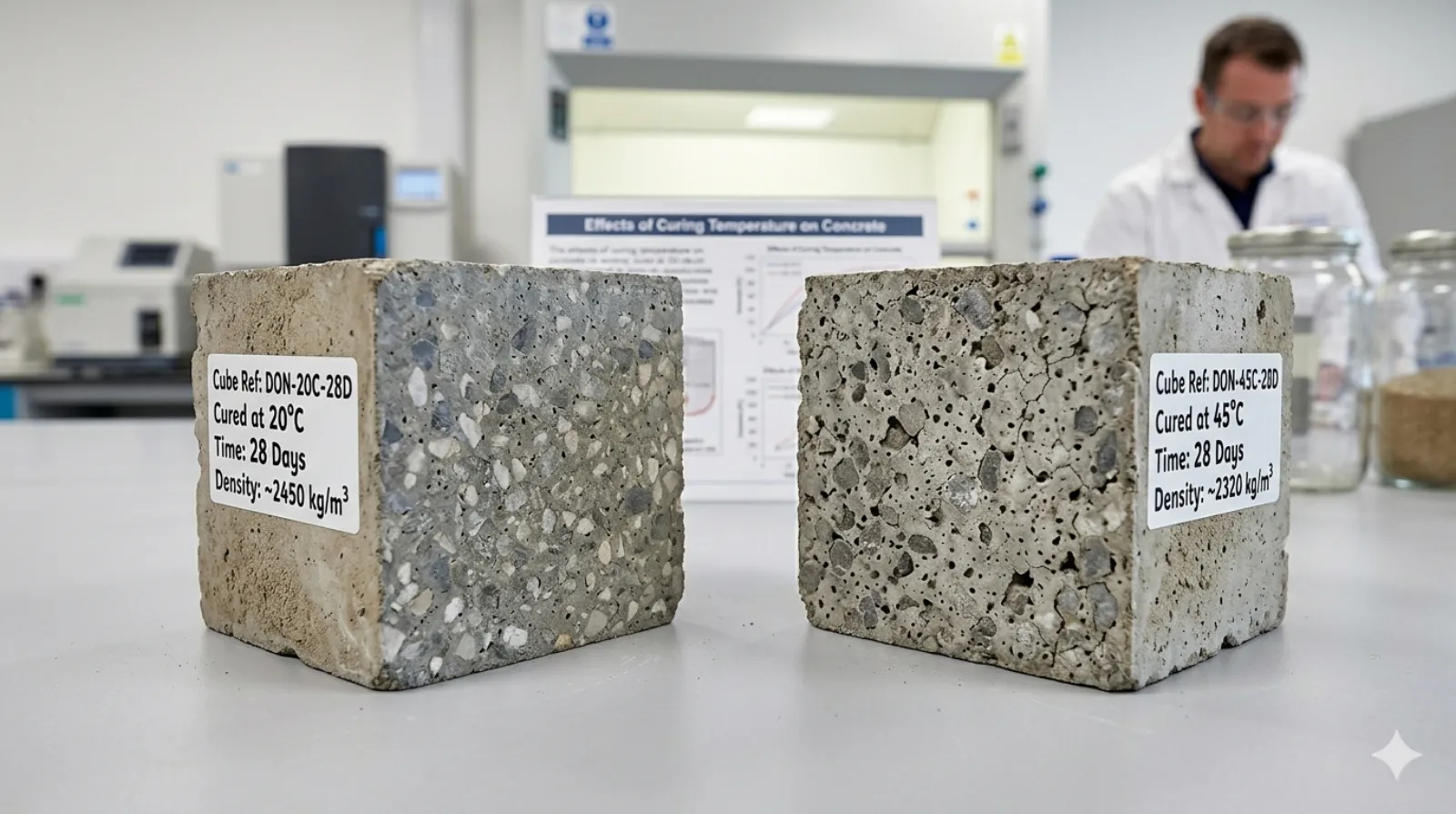
Temperature and hydration
Cement hydration is a chemical reaction, and like all chemical reactions, its rate depends on temperature. Higher temperatures accelerate hydration; lower temperatures slow it down. Below about −10°C, hydration essentially stops. Above 60°C, it races ahead but with consequences.
This temperature dependence means that two identical concrete mixes, placed at the same time, will have very different strengths at 7 or 28 days if one is cured at 5°C and the other at 35°C. Understanding this relationship is essential for anything from stripping formwork safely to predicting when a floor slab can take load.
The basic pattern
At higher curing temperatures:
- Early strength is higher — hydration is faster, so 1-day and 3-day strengths increase significantly
- Ultimate strength may be lower — rapid early hydration produces a coarser, less uniform microstructure with more capillary pores
At lower curing temperatures:
- Early strength is lower — hydration is slower
- Ultimate strength may be higher — the slower reaction produces a denser, more uniform gel structure
This is sometimes called the crossover effect: concrete cured at 10°C may have lower 7-day strength than concrete cured at 40°C, but higher 365-day strength. The fast-cured concrete "wins the sprint but loses the marathon."
Approximate relative strength development (same mix, different curing temperatures):
| Age | 5°C | 20°C | 35°C | |-----|-----|------|------| | 1 day | 15% | 25% | 40% | | 3 days | 30% | 45% | 60% | | 7 days | 50% | 65% | 80% | | 28 days | 80% | 100% | 95% | | 90 days | 95% | 105% | 90% |
Values shown as percentage of 28-day strength at 20°C. Note how the 35°C concrete peaks early but ends up weaker at later ages.
The Nurse-Saul maturity method
In 1951, Saul formalised what site engineers had observed empirically: concrete strength correlates better with the cumulative temperature history than with age alone. This is the maturity concept.
The Nurse-Saul maturity function calculates a maturity index (M):
M = Σ (T − T₀) × Δt
Where:
- T = average concrete temperature during time interval Δt (°C)
- T₀ = datum temperature, below which hydration is assumed to stop (typically −10°C or −11°C)
- Δt = time interval (hours)
- M = maturity (°C·hours)
The key insight is that concrete at 30°C for 1 day has similar maturity to concrete at 10°C for 2 days (assuming T₀ = −10°C):
- 30°C case: M = (30 − (−10)) × 24 = 960 °C·h
- 10°C case: M = (10 − (−10)) × 48 = 960 °C·h
If the maturity is the same, the strength should be approximately the same. This allows you to predict strength based on temperature history rather than just waiting for a fixed number of days.
Practical example: You need to strip formwork when concrete reaches 10 MPa. At 20°C, trial data shows this happens at a maturity of 500 °C·h. It's winter and the average concrete temperature is 8°C.
Time required: 500 / (8 − (−10)) = 500 / 18 = 27.8 hours
At 20°C, the same strength would be reached in 500 / 30 = 16.7 hours. The cold weather adds about 11 hours to the stripping time.
Limitations of Nurse-Saul
The Nurse-Saul method is simple and widely used, but it has known limitations:
It assumes a linear temperature-rate relationship. In reality, the rate of hydration increases more than linearly with temperature. The Arrhenius-based maturity function (also called the equivalent age method) handles this better, but requires the activation energy of the specific cement.
The crossover effect isn't captured. Nurse-Saul predicts that concrete cured hot and cold will reach the same ultimate strength at the same maturity — but we know hot-cured concrete often has lower ultimate strength. For early-age predictions (up to 7 equivalent days), the method works reasonably well. For long-term predictions, treat it with caution.
Cement type matters. The datum temperature and the strength-maturity relationship vary with cement type. A relationship calibrated for OPC won't work for a 70% GGBS blend. Always calibrate with your actual materials.
Hot weather concreting
When ambient temperatures exceed 30–35°C, concrete quality can suffer in several ways:
Increased water demand. Higher temperatures increase the rate of slump loss. The temptation to add water on site is strong — and destructive. Use retarding admixtures instead.
Rapid setting. There's less time to transport, place, and finish. Plan accordingly: shorter haul times, more labour, and consider retarders.
Plastic shrinkage cracking. High temperatures combined with wind and low humidity cause rapid surface drying. The surface shrinks while the interior is still plastic, causing characteristic map cracking. Fog spraying, windbreaks, and evaporation retarders help.
Reduced ultimate strength. As discussed, the crossover effect means hot-cured concrete may not reach its potential long-term strength.
Practical measures:
- Use chilled mixing water or ice as partial water replacement
- Schedule pours for early morning or evening
- Shade aggregate stockpiles
- Use retarding admixtures
- Begin curing immediately after finishing
- Consider specifying 56-day strength instead of 28-day to allow for slower development
Cold weather concreting
When temperatures drop below 5°C, hydration slows dramatically. Below 0°C, the water in fresh concrete can freeze, causing irreversible damage — ice crystals disrupt the forming gel structure and create voids.
The critical period is the first 24–48 hours. Once concrete reaches a strength of about 3.5–5 MPa, it has developed enough internal structure to resist frost damage. Getting through this vulnerable period is the primary objective of cold weather protection.
Practical measures:
- Use heated mixing water (up to 60–80°C) to raise the fresh concrete temperature
- Insulate formwork with thermal blankets
- Use accelerating admixtures (calcium chloride for unreinforced concrete, non-chloride accelerators for reinforced)
- Use OPC or rapid-hardening cement — this is one situation where fast early strength genuinely matters
- Protect surfaces from freezing for at least 48 hours (longer for blended cements)
- Avoid PPC or PSC with high replacement levels — their slow early hydration makes them more vulnerable to frost
Temperature monitoring: Place thermocouples in the concrete (at the core and at the surface) and log temperatures throughout the curing period. This data serves two purposes: verifying that the concrete didn't freeze, and calculating maturity for strength estimation.
The maturity method in practice
Modern maturity systems use embedded temperature sensors (thermocouples or wireless loggers) and software that continuously calculates maturity and estimates strength based on a pre-calibrated strength-maturity curve.
The calibration process:
- Cast a set of cubes or cylinders from the same mix
- Cure them at a reference temperature (usually 20°C) with embedded temperature sensors
- Test at 1, 3, 7, 14, and 28 days
- Plot strength vs maturity
- Fit a curve (logarithmic or hyperbolic)
Once calibrated, the system can predict in-situ strength at any point in the structure, in real-time, based on the temperature history at that location. This is enormously valuable for:
- Determining safe formwork striking times
- Deciding when post-tensioning can proceed
- Scheduling floor loading for multi-storey construction
- Providing evidence of compliance without waiting for cube results
Key takeaways
-
Temperature is as important as age for strength development. Don't assume 28 days means 28-day strength — it depends on what the temperature was during those 28 days.
-
Hot weather hurts long-term strength. Fast early gains come at a cost. Consider specifying later-age testing.
-
Cold weather demands protection. The first 48 hours are critical. Insulate, heat, and monitor.
-
Maturity methods work. For critical pours, install temperature sensors and use maturity calculations to make informed decisions about stripping, loading, and stressing.
-
Calibrate with your materials. Generic strength-maturity curves are approximate. For important work, calibrate with your actual mix and cement.
Model the effect of curing temperature on your mix with our strength predictor.