Why Probabilistic Mix Design Beats Rules of Thumb
The problem with deterministic design
Most concrete mix design, as it's practiced day-to-day, is essentially deterministic. You pick a w/c ratio from a table, calculate the cement content, assume the aggregates behave as expected, and predict a single strength value. If the table says w/c 0.50 gives 37 MPa at 28 days, that's what you design to.
But concrete doesn't produce a single strength value. It produces a distribution. Every batch is slightly different. The aggregate moisture varies. The cement strength varies from delivery to delivery. The air content fluctuates. The curing temperature on site isn't what the lab assumed.
The result is that your "37 MPa" concrete might actually give you anything from 30 to 45 MPa, depending on which combination of variations happens to line up on a given pour. Deterministic design ignores this reality. Probabilistic design embraces it.
Sources of variability
To understand why probabilistic methods matter, you need to appreciate how many variables are in play — and how they interact.
Cement strength variability. Cement is tested to EN 196 and sold with a declared strength class (e.g., 42.5 or 52.5 MPa). But the actual 28-day strength of the cement varies from batch to batch. A CEM I 42.5N might have a mean strength of 52 MPa with a standard deviation of 3 MPa. That variation propagates directly into the concrete strength.
Aggregate moisture. Fine aggregate moisture can vary by 2–4% within a single stockpile. Since free water content directly affects the w/c ratio, a 2% error in moisture measurement on 700 kg of sand means 14 litres of unaccounted water — enough to shift the w/c by about 0.03.
Batching tolerances. Even a well-calibrated plant has tolerances: ±1% on aggregates, ±1% on water, ±2% on cement (per EN 206). These tolerances interact — worst case, they compound.
Air content. Entrained or entrapped air content varies by ±1–1.5%. Each 1% of air reduces strength by approximately 5%.
Curing conditions. The temperature on a building site is not a controlled 20°C. It might be 8°C in November or 32°C in July. As we've discussed, this significantly affects strength development.
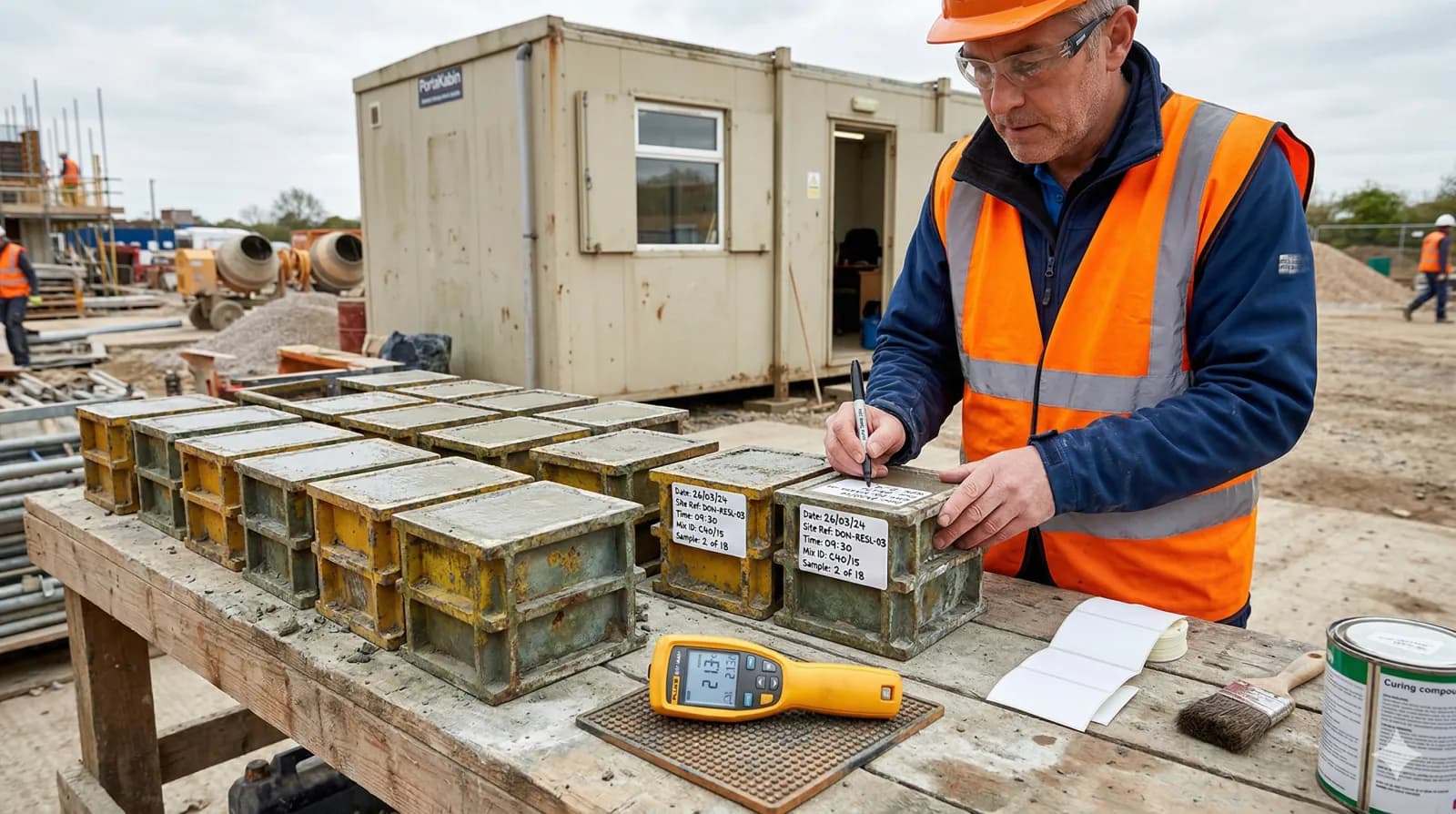
Testing variability. Even the cube test itself has a coefficient of variation of 3–5%. Two cubes from the same batch, tested at the same age, won't give identical results.
When you stack all of these up, the total coefficient of variation for concrete strength is typically 10–20%. For a mean strength of 40 MPa, that's a standard deviation of 4–8 MPa. The deterministic "single number" from the mix design table is, at best, the centre of a wide probability distribution.
What probabilistic design does differently
Instead of calculating a single predicted strength, probabilistic design asks: what is the probability of achieving the required strength, given all the sources of variability?
This changes the question from "what strength will I get?" (which has no single correct answer) to "how likely am I to comply?" (which is actionable).
The approach:
- Define each input variable as a distribution (not a single value)
- Propagate those distributions through the strength prediction model
- Obtain a distribution of predicted strengths
- Calculate the probability of compliance (i.e., what percentage of results exceed the characteristic strength)
Monte Carlo simulation
The most common computational method for probabilistic mix design is Monte Carlo simulation. The name sounds exotic, but the concept is simple:
- Randomly sample a value for each input variable from its distribution
- Calculate the resulting concrete strength
- Repeat thousands of times (10,000 is typical)
- Analyse the distribution of results
Example setup:
| Variable | Distribution | Mean | Std dev | |----------|-------------|------|---------| | Cement strength | Normal | 52 MPa | 3 MPa | | w/c ratio | Normal | 0.50 | 0.02 | | Air content | Normal | 1.5% | 0.5% | | Curing temperature | Normal | 18°C | 4°C |
Each simulation run randomly picks one value from each distribution, feeds them through a strength model (such as Bolomey's or a regression model), and produces one predicted strength. After 10,000 runs, you have a histogram of 10,000 predicted strengths.
From this histogram, you can read off:
- The mean predicted strength
- The standard deviation
- The 5th percentile (your characteristic strength)
- The probability of any individual result falling below a specified threshold
What Monte Carlo reveals
The results are often humbling. A mix that deterministically "should" give 37 MPa might show:
- Mean: 38 MPa
- Standard deviation: 5.2 MPa
- 5th percentile: 29.4 MPa
- Probability of result < 30 MPa: 6.2%
So your C30/37 mix, which looked comfortable on paper, actually has a 6% chance of individual results falling below 30 MPa. Whether that's acceptable depends on your conformity criteria and risk tolerance — but at least now you know.
Conversely, a mix that deterministically looks marginal might turn out to be perfectly adequate when you account for the correlations between variables (e.g., high cement strength partially compensates for slightly higher w/c).
Practical benefits
Better margin calibration. Instead of applying a blanket margin of 1.645 × assumed standard deviation, you can set the margin based on the actual predicted variability of your specific mix with your specific materials and your specific quality control. This is more accurate and usually results in lower (but still safe) margins.
Identifying the critical variables. Monte Carlo simulation lets you run a sensitivity analysis: which input variable has the most influence on the output distribution? If cement strength variability contributes 60% of the output variance while aggregate moisture contributes 10%, you know where to focus your quality control investment.
In practice, the dominant variables are usually:
- w/c ratio variability (driven by aggregate moisture control)
- Cement strength variability
- Air content variability
These three typically account for 80–90% of the total strength variability.
Optimising cost with known risk. The real power of probabilistic design is that it lets you trade off cost against risk of non-compliance in a quantified way.
Example: reducing cement by 10 kg/m³ saves £1.20/m³ but increases the probability of a non-compliant result from 2% to 4%. On 20,000 m³, that's a £24,000 saving. Is the increased risk acceptable? With deterministic design, you can't even frame the question. With probabilistic design, you can make an informed decision.
Handling blended cements. Blended cements (PPC, PSC) have more complex strength development curves and interact with curing temperature differently than OPC. Rules of thumb that work for OPC often fail for high-GGBS mixes. A Monte Carlo model calibrated to your actual blended cement data will give more reliable predictions.
Rules of thumb vs reality
Consider some common rules of thumb:
"Add 7.5 MPa margin for cube target mean" — This assumes a standard deviation of about 4.5 MPa, which may or may not match your production. If your actual σ is 3 MPa, you're wasting cement. If it's 7 MPa, you're under-designing.
"w/c 0.50 gives 37 MPa" — Depends on the cement type, cement strength class, aggregate type, air content, and curing conditions. The actual range for w/c 0.50 across different situations might be 28–45 MPa.
"Increase cement by 10 kg for each 1 MPa of extra strength" — Approximately true near the middle of the range, but the relationship between cement content and strength is nonlinear. At high cement contents, each additional 10 kg gives diminishing returns.
None of these rules of thumb are wrong in the sense that they're grossly misleading. They're adequate starting points. But they lack the resolution needed for optimisation. When you're trying to save £1–3 per cubic metre across thousands of cubes, "approximately right" isn't good enough. You need the distribution.
Getting started
You don't need specialised software to run basic Monte Carlo simulations. A spreadsheet with random number generation can do it. But purpose-built tools are more efficient and less error-prone.
The steps:
- Characterise your input distributions. This means analysing your production data: cement test certificates, aggregate moisture records, batching logs, and cube results.
- Build or select a strength model. Regression models fitted to your historical data work well. Bolomey's formula is a reasonable starting point.
- Run the simulation. 10,000 iterations is sufficient for most purposes.
- Analyse results. Focus on the 5th percentile, the probability of non-compliance, and the sensitivity to each input.
- Iterate. Adjust the mix and re-run until you find the optimum balance of cost and compliance risk.
The initial effort is moderate, but once the model is built, re-running it for new mixes or updated data takes minutes.
Try our strength predictor to explore how variability affects your predicted outcomes, or use the cost optimiser to find the most economical mix that still meets your compliance requirements.